When is a pair not a pair? When it's
The Guess Who half of A Wild Pair.
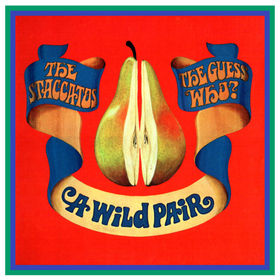
Released in the spring of 1968, the WILD
PAIR album coupled The Staccatos, a
quintet from Ottawa, on Side A with
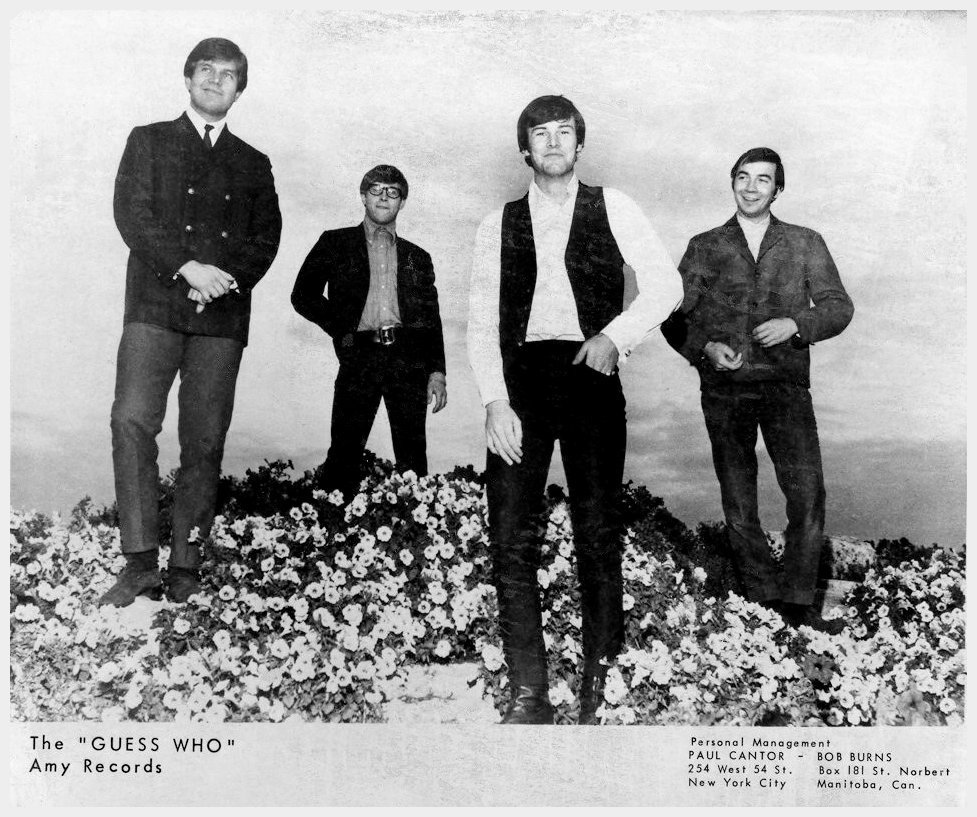
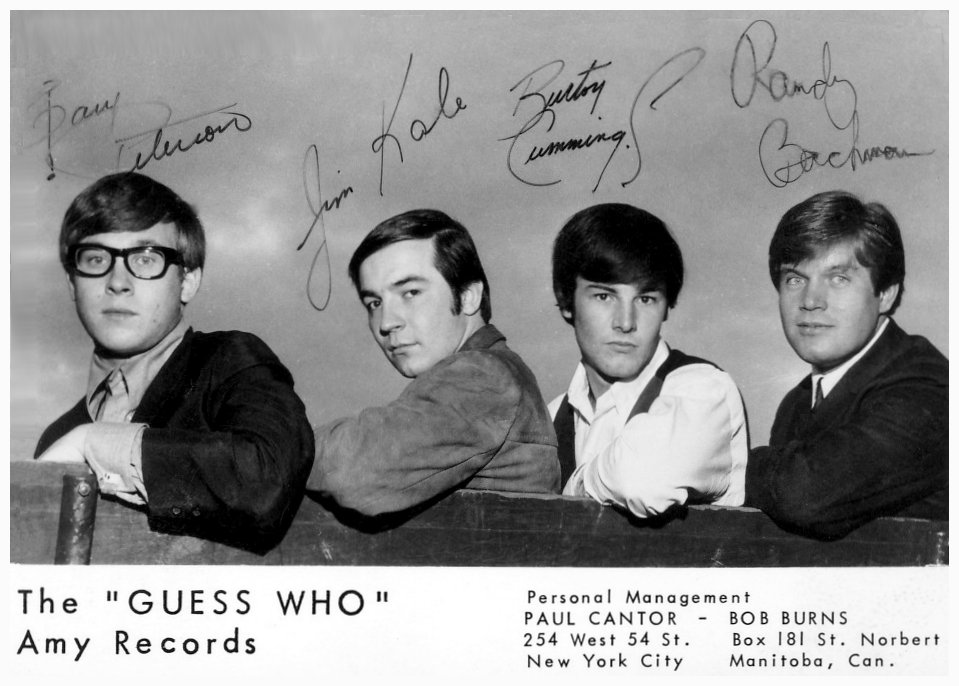
Winnipeg's favorite sons The Guess Who -
Randy Bachman, Burton Cummings, Jim Kale,
and Garry Peterson - on Side B. What
you have in your hands is half that pair,
plus some intriguing rare bonus tracks.
While the group's breakthrough album
WHEATFIELD SOUL with its stunning
million-selling hit single These Eyes
would launch The Guess Who as a group,
along with the songwriting partnership of
Bachman-Cummings, into the rock 'n' roll
stratosphere the following year, A WILD
PAIR laid the all-important groundwork for
that success. Frankly, the latter
could not have happened without the
former. Confirms veteran Canadian
music journalist and Billboard
correspondent Larry Leblanc, "A WILD PAIR,
indeed, was a transition album for The
Guess Who. Without it, and the
confidence in their songwriting, there
wouldn't have been WHEATFIELD SOUL."
Just as REVOLVER had served notice of The
Beatles creativity and imagination
blossoming beyond the limited confines of
the standard pop song format thus setting
the stage for the brilliantly innovative
pastiche of the SGT. PEPPER album, A WILD
PAIR'S experimentation with orchestral
instrumentation and arrangements coupled
with burgeoning songwriting talent was the
precursor to the polished professionalism
of WHEATFIELD SOUL.
And the catalyst for this transformation
was, oddly enough, Coca-Cola. In the
United States, pop stars pitching products
had already proven to be a lucrative
venture for Madison Avenue's ad agencies
ever eager to tap into the teen
market. Canada was a whole different
story, however. Did we have our own
legitimate homegrown pop sensations worthy
enough to hitch a corporate logo to?
Canada barely had its own music industry
let alone nationally-recognized
stars. Toronto-based musician and
jingle-writer Jack Richardson believed it
was possible.
"I actually got involved with The Guess
Who when I was with McCann-Erickson, the
advertising agency for Coca-Cola," recalls
Jack, on the start of what would become
one of the most celebrated relationships
in Canadian music history.
"We developed this youth radio campaign
whereby we decided to use younger
spokespeople for our product. We did
a series of radio commercials using
Canadian acts like JB and the Playboys,
David Clayton Thomas, Robbie Lane and the
Disciples. The jingles were based on
the songs these artists were relatively
well-known for and we ran them in 30, 60
and 90 second spots. The Guess Who
was one of the acts we approached".
Already experienced hands at crafting
jingles for the likes of Honda (Two-Wheel
Freedom on a Honda) and, by the fall
of 1967, established television stars on
the Winnipeg edition of CBC-TV's popular
Let's Go show, The Guess Who was an
obvious choice for the ad campaign.
They were Canada's best-known group having
cracked the American charts two years
earlier with their hit Shakin' All
Over.
"One of our dreams had been to do a Coke
commercial," notes guitarist and group
leader Randy Bachman. "Ray Charles
had done one and we thought it was
cool." Jack brought The Guess Who to
Toronto's Hallmark Studios to cut radio
jingles for Coke incorporating the soft
drink's signature slogan "Things go better
with Coke!" into two of the group's
biggest Canadian hits, Shakin' All
Over and This Time Long Ago
(the former included on this CD for the
first time).
"The outcome of that," recalls Jack "was
that the agency recommended we put
together a compilation album from the
catalogues of these artists. I
suggested it would be better to go with
something original. The first one we
did was with Bobby Curtola and it was so
successful they decided to do it
again. That became A WILD PAIR with
The Guess Who on one side and the
Staccatos on the other."
What attracted Jack to the Winnipeg band?
"The songs, they were good players, and I
felt that Burton Cummings had a
charismatic quality to him that seemed
ready to explode," he remembers.
"Having worked with them on the
commercials and knowing that there were
relatively few bands at that point in time
that had any profile nationally across
Canada, The Guess Who had that with the
CBC television show and their previous
records."
Confirms Larry Leblanc, "There really
wasn't another group on a national level
like The Guess Who. All the other
bands across the country were
regional. The Guess Who were big
across Canada."
The combination of Jack Richardson's
studio savvy, arranging experience and
commercial ear coupled with the talent and
determination of the four Winnipeggers
proved fortuitous and, ultimately,
successful far beyond the imaginations of
any of them at that point.
"I had been in the music business since
1947," recounts Jack, "and had worked with
a lot of international performers in a lot
of different studios and had more
experience, probably more than most in the
country at that time. So coming
together was a very compatible situation
for both of us. We both had
something to offer."
In the meantime, The Guess Who continued
in their role as resident band on Let's Go
covering the hits of the day as well as
slipping in some of their favourite
numbers from the flowering psychedelic
scene. Among those were the
Yardbirds' searing blues shuffle The
Nazz Are Blue that boasts the most
amazing single note sustained guitar solo
in music history (ably covered by Randy
with his new innovation the Herzog
pre-amplifier, developed with Garnet
Amplifier's Gar Gillies) and Vanilla
Fudge's pounding treatment of The
Supremes' hit You Keep Me Hangin' On,
both handled meticulously by The Guess Who
revealing once again the group's uncanny
ability to mimic the latest trends without
missing a hook, lick or nuance. In the
Winnipeg group's hands The Beatles'
evergreen Hey Jude receives
sympathetic treatment as does British
rivals The Rolling Stones' return to a
rockin' sound with the driving Jumpin'
Jack Flash. Years of playing
cover tunes had served The Guess Who well.
Boasts Randy, "Not only did we play the
songs perfectly, we sounded exactly like
the records."
When the call came from Jack Richardson to
provide suitable material for an entire
album side, Randy and Burton jumped at the
opportunity.
"This was the first time Burton and I had
a serious assignment or goal for
songwriting," Randy enthuses. "Up to
then it had been just dabbling with no set
goal or usage. So when we were asked
to do the WILD PAIR album, it was a
challenge to 'go for our dreams' at being
a Lennon-McCartney, Jagger-Richards, or
Bacharach-David songwriting team.
The plan was that both bands would record
all original material. So we set to
work every Saturday afternoon at Burton's
Mom's house on Bannerman. It was a
very prolific time for us both
collaboratively and alone."
Although ostensibly still writing
individually, the seeds of the
Bachman-Cummings team were already sown
that fall. Each writer presented his
ideas - whether fragments or completed
songs - to the other for critique; from
that the two began a fruitful
collaboration.
Sessions convened at Toronto's three-track
Hallmark Studios in late 1967.
"I was pretty young then, eighteen or
nineteen," muses Burton, "and I remember
this feeling of being in the big time on
those sessions."
Randy concurs. "Studios were in
their infancy in Canada. Winnipeg
didn't have any, so for us to go to a
studio in Toronto was a big deal."
For the first time in the group's lengthy
recording career they would have the full
gamut of musical resources at their
disposal. Used to a 'get in, set up,
record and get out in three hours'
regimen, now they could take their time
and experiment with a variety of
instruments and accompaniment, and the
results would be mind-blowing.
"There was a thirty-piece orchestra on
that album," boasts Burton, "a lot of
strings and horns. We even had the
harp player from The Friendly Giant on the
sessions." Ben McPeek provided the
orchestral arrangements.
"Ben was a very well-respected Toronto
music arranger," notes Randy, "who had
done symphonic pieces as well as
commercials. He took our songs and
added strings and horns."
Burton recalls another feature that marked
the sessions. "I remember huge
coolers of Coca-Cola on ice everywhere we
looked in the studio. Tons and tons
of Coke."
Up first is Randy's majestic I Need
Your Company, described by him as
"my attempt at being Jimmy Webb using
major seventh chords. Burton's vocal
on that was absolutely perfect and the
orchestration was understated enough to
compliment the song. The middle
eight was me copying You've Lost That
Lovin' Feeling."
Indeed, Burton renders his most sensitive
vocal performance to that point in his
recording career. The song closes
out with his invocation to the sax man to
play the song out as it kicks into a whole
other gear in a jazzy fade showcasing
drummer Garry Peterson's versatility.
Bachman-Cummings collaboration, is a
whimsical number boasting the group's
signature vocal harmonies alongside a full
brass section. Reminiscent of Spanky
and Our Gang's hits, Randy suggests,
"Burton and I were trying to write a
Turtles kind of Happy Together
song with that one."
Very Far From Near offers Burton's
own interpretation of British pop pioneers
Cliff Richard and the Shadows' style of
ballad featuring another example of his
tremendous vocal abilities, with some
subtle wah-wah guitar from Randy in the
background. At the height of the
group's later success, Burton would come
to be acknowledged far and wide as
possessing the finest voice in rock music,
a claim well-supported on A WILD
PAIR. In addition, if you listen to
the choruses of each song you can clearly
hear the voice of bass player Jim Kale
whose harmonies were often at the core of
the Guess Who's hallmark vocal blend.
The group's earlier jingles work with Jack
had introduced them to the cream of the
Toronto session players, many of whom
returned for the WILD PAIR sessions.
"We got to work with the Toronto A team,"
Randy recalls, "the top players on the
scene mostly from the jazz world like
Guido Basso, Ed Bickert, Don Thompson, and
Moe Kaufman."
Notes Garry Peterson, "These guys were
really heavy jazz cats, great
players. At that time a lot of jazz
players would look down their noses at
rock 'n' roll players but they were really
nice to us. We had a lot of fun
hanging out with these guys in the
studio. They were great guys."
One session player stood out above the
others.
"We were introduced to Hagood Hardy,"
remembers Burton, who along with Randy was
moved to compose a song around the
acclaimed piano/vibraphone player's
unusual moniker.
"The name Hagood Hardy was so
unique. That was a name that wasn't
exactly Jim Smith. I thought it was
cool and figured 'Let's make up some
gobbledy-gook lyrics using that name'."
Chuckles Randy, "Burton and I each wrote a
song around his name. Burton's was
better than mine, we both knew it, so we
cut it for the album. I did some
incredible Hendrix style guitar with my
Herzog and wah-wah pedal but it was mixed
out. I was disappointed they only
left a little bit in the fade out. Heygoode
Hardy was really over the top in
terms of arrangement with wild trumpets
everywhere."
The closing track, Randy's gorgeous
Somewhere Up High, is his attempt
to emulate the baroque-rock style of New
York group The Left Banke.
"That song was my own Walk Away Renee
with cellos," he admits.
Suggests Burton, "Somewhere Up High
had these beautiful string lines that were
very reminiscent of George Martin and what
he did with the Beatles."
Bathed in lush orchestration, the song
offers a fitting conclusion not only to
The Guess Who's tracks but to the WILD
PAIR album itself.
A further key ingredient in the overall
sonorous sound quality and impact of the
album was the recruitment of an engineer
from New York.
"Jack brought in a new young mixer,"
recalls Randy, and we said, "What's a
mixer? We had never worked with one
before. We learned that he balances
the sounds between the instruments.
The guy turned out to be Phil Ramone who
we met for the first time. That's
why A WILD PAIR sounds so darn good.
The sound is incredible."
Though Ramone would go on to enjoy
tremendous success with artists like Billy
Joel, the WILD PAIR sessions were
memorable for him. "Jack hired me
and I thought it was kind of fun that the
groups were doing a record as a giveaway
for promotion," he recalls. "I think
we did one band on one day, and the other
the next. We only had so many
hours."
With sessions completed, The Guess Who
returned to Winnipeg and resumed their
weekly duties on Let's Go. They had
already debuted the five WILD PAIR tracks
on the show prior to the sessions,
featuring orchestral arrangements provided
by CBC music director Bob McMullin (heard
here for the very first time on CD).
Soon after, Coca-Cola began promoting the
album in earnest across Canada. Not
available in record stores, fans purchased
A WILD PAIR by mailing in twelve Coca-Cola
bottle cap liners and a dollar.
Within a matter of months the album had
sold over 80,000 copies, a staggering sum
for the fledgling Canadian music industry,
largely without the benefit of radio
support, notes Larry Leblanc. "Radio
played little of it, certainly in
Toronto. There was little promotion
of the package to Canadian radio
programmers. The only promotion
involved was advertising on TV and radio
spots sponsored by Coke."
"We couldn't get a gold record for it
because it wasn't sold through retail
outlets," laments Randy, "but it was one
of the biggest selling albums in Canada up
to that point." Jack sites another
positive outcome of the album's triumph.
"The WILD PAIR album was one of the
reasons The Guess Who stayed together," he
suggests, "because at that time they were
on the verge of breaking up due to severe
economic straits." The group was
still straining under the weight of a
crippling debt from their ill-fated trip
to Britain.
The unprecedented success of A WILD PAIR
was the first indication that a viable
national Canadian music industry could,
indeed, exist. "That was quite a
feat for the Canadian market," stresses
Jack. "Back then it was really the
birth of an industry in Canada."
It also rang bells with Jack and his
partners. "I felt there was a
tremendous amount of talent in the group
and that became the motivation behind us
taking the flyer and forming Nimbus 9
Productions. We approached both the
Staccatos and The Guess Who with the idea
of coming with us as a production
group. The Guess Who agreed and we
bought out their Quality Records contract
for $1000. The Staccatos chose to
stay with Capitol Records, so it was one
of those 'win one, lose one'
situations. But I think we won the
best one." Phil Ramone agrees.
"Jack was totally enamoured with the fact
that the band was so good," he
maintains. "We all were. They
were just incredible. Burton had his
own vocal sound, a radio-friendly voice
that you can pick out of the crowd, and
made that sound become a part of his
identity. He didn't imitate anybody
else."
The impact of the album on The Guess Who's
climb to the top cannot be understated.
"Following the success of A WILD PAIR,"
recalls Randy, "Jack informed us that he
wanted to do an entire album with us and
instructed Burton and I to write more
songs. That was validation for us
that we were songwriters. And we, in
turn, had confidence in Jack. He saw
something in us that no one else did, or
would admit to, and was willing to put his
money where his mouth was. He was
willing to gamble on the band and that
really floored us." Jack would
mortgage his own house to finance sessions
in New York later that year for Wheatfield
Soul. "To him, we were worth the
risk," he adds.
The first order of business was a single
to capitalize on A WILD PAIR'S
success. The group returned to
Hallmark Studios in Toronto to cut several
tracks including the Bachman-Cummings
compositions Of a Dropping Pin and
When Friends Fall Out.
"When Friends Fall Out is a little
masterpiece," offers Randy, "the beat, the
solos, the bridge with all of us singing
like the Strawberry Alarm Clock."
The track was backed by the rockin' Guess
Who Blues, a number that recounts
the group's many ups and downs over the
previous years and boasts some blistering
Claptonesque guitar playing from
Randy. Although both singles failed
to make much headway on the Canadian
charts, Jack believed the band needed an
album to showcase their diverse sounds so
sessions were booked at A&R Studios in
New York in mid-September 1968. He
then approached RCA in New York.
"Nimbus had a distribution deal with RCA
in Canada," relates Jack, "and Of a
Dropping Pin was the first
single. Although it wasn't a huge
success, Andy Nagy at RCA in Montreal felt
there was something there and called his
head office in New York. I flew to
New York to meet with Don Burkhimer at RCA
based on the single Of a Dropping Pin.
There was no mention of an album in the
pipeline; we had just completed it.
Don wasn't aware of the album. I
brought along an acetate of WHEATFIELD
SOUL and after our conversation, I asked
him if he would mind listening to it and
giving me his opinion. Don sat and
listened to the entire record, which was
very unusual for an A and R man, let me
tell you, and when it was done he looked
at me and said 'Jack, These Eyes
is a smash hit.' I came back to
Canada and told the boys that we were
going with These Eyes as the single, that
RCA felt the same way, and that we had a
potential deal with them on that
basis. That's where it all started
and Of a Dropping Pin
was the entrée so to speak."
"As you can see by these tracks, we were
still learning to write by emulating songs
we loved," surmises Randy. "There
was a transition after this where we
became better at it and the next batch of
songs we wrote was the These Eyes
batch where the influences were left more
behind. We now had confidence in our
own ideas with only hints of other
songs. But the magnitude of A WILD
PAIR on our evolution was
immeasurable. The album was a
further step up in terms of our level of
sophistication. Burton and I honed
our writing skills and it introduced us to
Jack Richardson who gave our sound a whole
new context."
The degree of songwriting maturity and
arranging over a mere eighteen months,
from Believe Me and If You
Don't Want Me to Somewhere Up
High and Very Far From Near,
represents an extraordinary creative
quantum leap that would continue to
blossom over the next two years.
Clearly, Randy and Burton were now
painting from a far richer, more colourful
palette.
"Everything was incremental," muses Randy,
"from His Girl, to the London This
Time Long Ago sessions with Tony
Hiller, to A WILD PAIR with Jack
Richardson. Working with producers
who knew what they were doing was a huge
step for us."
The release of the WILD PAIR tracks on CD
draws the final curtain on The Guess Who's
early career. On the strength of
these initial recordings with Jack
Richardson, the group would sign to RCA
Records in New York and never look back (a
countrified take on Close Up The Honky
Tonks is also included here for the
first time, one of the rarest of Guess Who
tracks and a joke recorded during the
American Woman sessions to tease RCA
executives). What followed A WILD
PAIR would forever alter the Canadian
music landscape, as well as the lives of
the four young men in The Guess Who.
John Einarson is the author of American Woman: The Story of The Guess Who
and Randy Bachman: Takin' Care of
Business, co-written with Randy
Bachman.
|